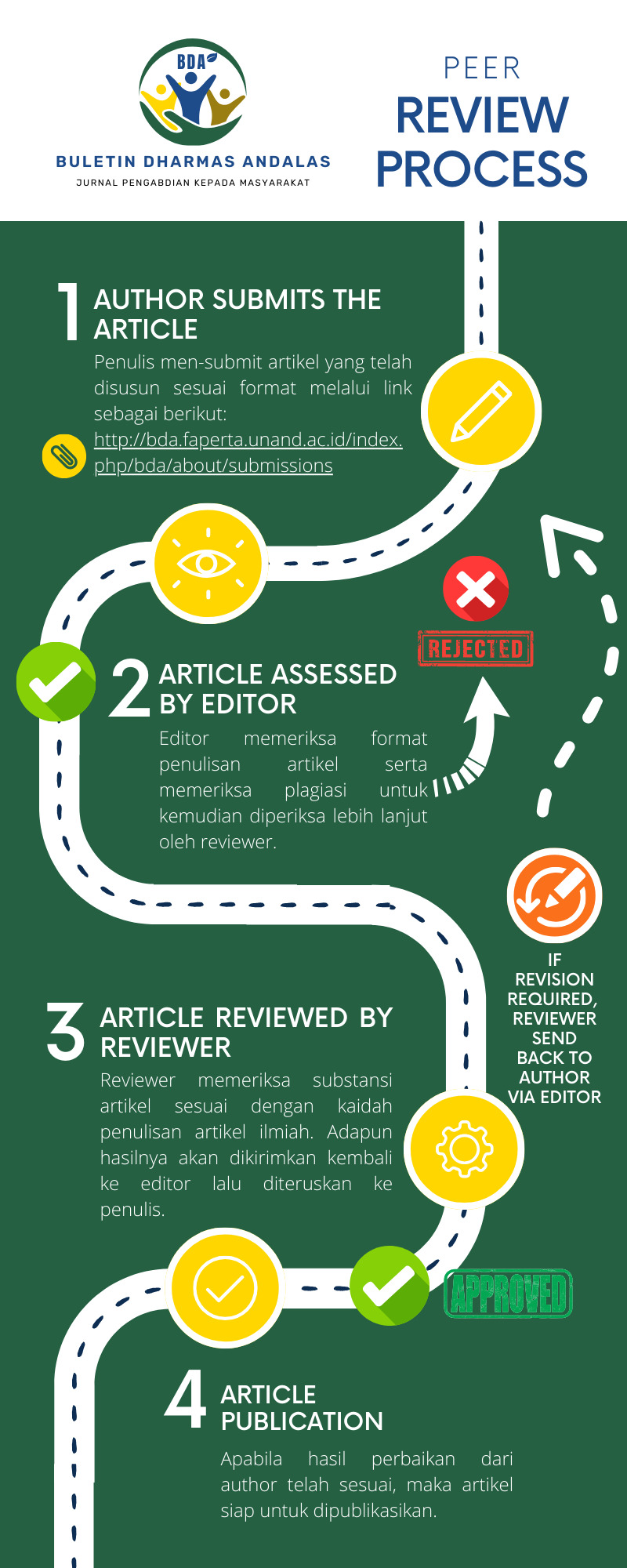
Peer Review Process
The Buletin Dharmas Andalas (BDA) follows a rigorous double-blind peer-review process to ensure the integrity, quality, and scholarly merit of all published articles. This process maintains the anonymity of both the authors and the reviewers, ensuring an unbiased evaluation of submissions. The journal upholds COPE’s Ethical Guidelines for Peer Reviewers and adheres to the highest standards of academic integrity and research transparency.
1. Initial Editorial Screening
Upon submission, each manuscript undergoes a preliminary evaluation by the Editor-in-Chief and the Editorial Board to determine its suitability for peer review. At this stage, the manuscript is assessed based on:
- Alignment with the journal’s focus and scope
- Compliance with submission guidelines
- Originality and absence of plagiarism (checked using plagiarism detection software)
- Overall clarity and structure of the manuscript
Manuscripts that fail to meet the journal’s criteria or contain ethical concerns may be desk-rejected without further review. Authors of desk-rejected submissions receive constructive feedback for potential resubmission.
2. Assignment of Peer Reviewers
Manuscripts that pass the initial screening are assigned to at least two independent peer reviewers with expertise in the relevant field. Reviewers are selected based on:
- Subject matter expertise
- Absence of conflicts of interest
- Previous peer-review experience
The journal ensures a diverse and balanced reviewer selection to maintain the credibility and impartiality of the evaluation process.
3. Double-Blind Peer Review Process
In this stage, the assigned reviewers assess the manuscript based on the following criteria:
- Scientific and methodological rigor
- Originality and contribution to knowledge
- Clarity, coherence, and logical argumentation
- Relevance to the journal’s scope and research community
- Adherence to ethical research standards
Reviewers provide constructive feedback and recommendations, categorizing the manuscript into one of the following decisions:
- Accept without revisions – The manuscript meets all quality standards and requires no modifications.
- Minor revisions required – The manuscript is accepted conditionally, with minor improvements needed.
- Major revisions required – The manuscript is promising but requires substantial modifications before reconsideration.
- Reject – The manuscript is unsuitable for publication due to significant flaws in content, methodology, or ethical concerns.
The review duration typically ranges from 4 to 6 weeks, but this may vary depending on reviewer availability and the complexity of the manuscript.
4. Author Revisions and Resubmission
If revisions are required, authors must:
- Address all reviewer comments systematically
- Revise the manuscript accordingly
- Submit a detailed response letter explaining how each revision was incorporated
The revised manuscript undergoes a second round of review, where reviewers evaluate whether the revisions adequately address their concerns.
5. Final Editorial Decision
Based on the reviewers’ recommendations, the Editor-in-Chief makes the final decision, which can be:
- Accept for publication
- Request further minor revisions
- Reject the manuscript if significant issues remain unresolved
The final decision is communicated to the authors, along with reviewers' feedback and editorial comments.
6. Copyediting, Proofreading, and Publication
Once accepted, the manuscript undergoes:
- Copyediting to refine clarity, grammar, and formatting
- Proofreading to correct typographical or minor errors
- Final layout preparation before online publication
The final version of the manuscript is then assigned a DOI and published in the next available issue of Buletin Dharmas Andalas (BDA) under the Creative Commons Attribution-NonCommercial-ShareAlike 4.0 International License (CC BY-NC-SA 4.0).
7. Post-Publication Discussion and Corrections
BDA encourages post-publication academic discussions, where readers can submit comments or critiques. Authors have the opportunity to respond and clarify their findings. If errors or ethical concerns arise post-publication, the journal follows COPE’s correction and retraction guidelines.